
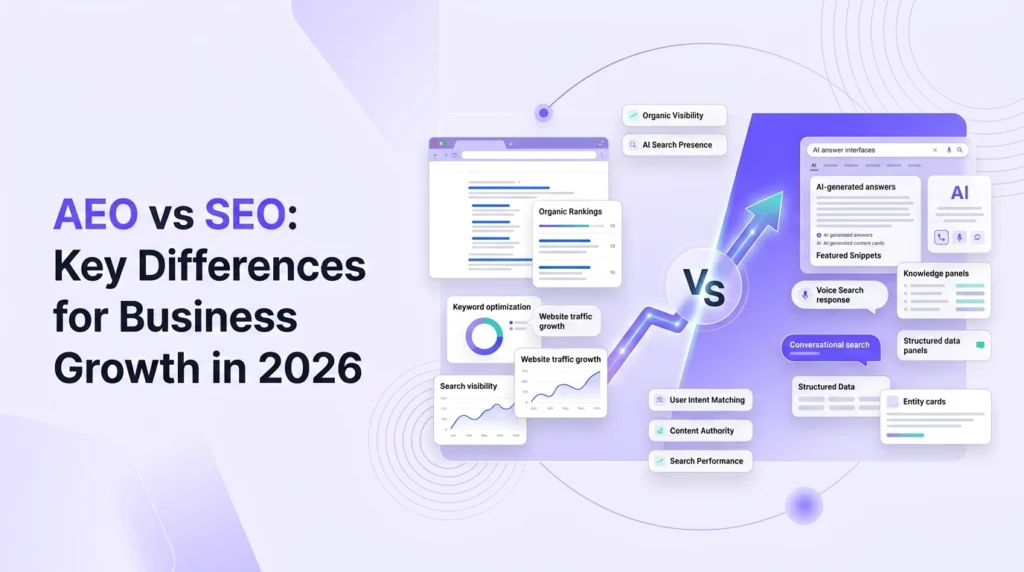
Search is not what it used to be. A few years ago, ranking on page one of Google felt like winning the lottery. Today, millions of users never even scroll past the first answer they see. That shift is exactly why the debate around AEO vs SEO has become one of the most important conversations in digital marketing right now.
If you run a business and care about online visibility, you need to understand both. Not just one or the other.
What Is SEO and Why It Still Matters
SEO, or Search Engine Optimization, is the practice of improving your website so search engines rank it higher in organic results. It covers everything from keyword research and on-page content to backlinks and technical performance.
Google processes over 8.5 billion searches every day according to Internet Live Stats. That number alone tells you SEO is far from dead. But the way SEO works has changed dramatically. Google’s ranking systems now evaluate content quality, user intent, topical authority, and real-world credibility. Thin content and keyword stuffing? Those tactics belong in a museum.
A strong SEO strategy in 2026 means building content that genuinely answers what users are searching for, at every stage of their journey. It means earning trust through consistent publishing, credible sourcing, and a website that loads fast on mobile.
What Is AEO and How Is It Different
AEO stands for Answer Engine Optimization. It focuses on optimizing your content to appear directly as answers inside AI tools, voice assistants, featured snippets, and platforms like ChatGPT, Perplexity, Google’s AI Overviews, and similar technologies.
The difference between SEO and AEO is not about one replacing the other. It is about audience behavior. SEO gets you ranked on a results page. AEO gets your content pulled directly into a response, often without the user visiting your website at all.
Think about it this way. You search “best time to post on Instagram.” SEO delivers ten blue links. AEO delivers a direct answer at the top, spoken by a voice assistant, or summarized inside an AI chat response. The user gets the answer without clicking anything.
That is both a challenge and an opportunity.
If you want your brand to be cited as a trusted source by AI tools, then an AEO strategy is no longer optional. It is a business necessity.
The Core Difference: Search Engine vs Answer Engine
A search engine vs answer engine comparison comes down to intent delivery. Search engines present options. Answer engines deliver conclusions.
Google has been quietly shifting toward answer engine behavior for years. Featured snippets, People Also Ask boxes, AI Overviews, and voice results all reflect this shift. Google wants users to find answers faster, ideally without leaving its ecosystem.
AEO optimizes for this behavior. It structures content in a way that AI systems can easily extract, verify, and surface. This includes using clear question-based headings, concise definitions, structured data markup (like Schema.org), and factually accurate information that AI tools can confidently cite.
SEO, on the other hand, still drives organic traffic through ranked links. It powers blog discovery, product pages, local business listings, and long-form educational content. Both roles are distinct and both remain valuable.
If you are exploring how to align your current digital presence with AEO best practices, working with a professional team that offers AEO Services can help you understand exactly where your content stands and what structured optimization looks like in practice.
Why Businesses Need Both Strategies in 2026
Here is the reality. Running SEO without AEO in 2026 is like having a beautiful storefront that nobody walks past anymore. And running AEO without SEO is like whispering into the air and hoping someone hears you.
Both work better together.
SEO builds your domain authority and organic presence. It helps users discover your brand through traditional search. AEO positions your brand as the go-to source when AI tools answer questions in your niche. When an AI cites your content as the authoritative answer on a topic, that is brand visibility without a single click being required.
According to a BrightEdge report, organic search still drives over 53% of all website traffic. At the same time, AI-generated answers are now influencing buying decisions across industries. Ignoring either side means leaving growth on the table.
Businesses that adapt now will have a significant head start. Those who wait will spend twice the effort trying to catch up.
How to Build an AEO Strategy That Works
Building an effective AEO strategy does not require tearing down everything you have done with SEO. It requires layering new thinking on top of your existing content foundation.
Start by auditing your content for question-based opportunities. What questions do your customers ask before buying? Build clear, direct answers to those questions inside your existing pages or as dedicated FAQ sections.
Use structured data markup to help AI systems understand your content. Schema.org offers markup for FAQs, how-to guides, products, reviews, and more. This makes it significantly easier for search engines and AI tools to extract and present your content as a trusted answer.
Focus heavily on E-E-A-T, which stands for Experience, Expertise, Authoritativeness, and Trustworthiness. Google’s Search Quality Rater Guidelines make clear that content demonstrating real-world expertise ranks better and gets cited more often by AI systems.
Keep your answers concise. AI tools prefer content that delivers clear answers in 40 to 60 words before expanding on the topic. Structure matters as much as substance.
If you want to understand more about how this process works from the ground up, What is AEO breaks it down in plain language with practical examples for businesses at any stage.
The Future of SEO and AEO: Where Are We Headed
The future of SEO and AEO is converging. Google, Bing, and emerging AI platforms are all moving toward intent-first, answer-first experiences. The traditional ten blue links model is becoming just one part of a much larger ecosystem.
Voice search already accounts for a significant portion of daily queries. AI assistants like Siri, Alexa, and Google Assistant respond using featured answers, not ranked pages. ChatGPT and Perplexity pull information from websites that demonstrate clear authority and structure.
This means content creators and businesses need to think beyond ranking. They need to think about being cited, referenced, and trusted by systems that synthesize information on behalf of users.
At the same time, Google has consistently confirmed that links and content authority still matter for ranking. SEO fundamentals are not disappearing. They are evolving. Core Web Vitals, helpful content signals, and topical depth remain ranking factors in 2026.
The businesses that will lead in this environment are the ones treating SEO and AEO as a unified strategy, not competing alternatives.
Practical Steps to Combine SEO and AEO Right Now
You do not need a massive budget or a team of twenty people to start. Here is what actually moves the needle.
Write content that answers real questions your audience asks. Use tools like Google’s People Also Ask, Answer the Public, or even ChatGPT prompts to identify those questions at scale. Structure your pages with clear H2 and H3 headings that mirror how someone would naturally ask a question.
Build internal links between related content to signal topical authority. Earn external backlinks from credible sources in your industry. Update old content regularly so AI tools see your site as fresh and reliable.
Invest in technical SEO. Page speed, mobile responsiveness, and clean crawlability are non-negotiable. A site that loads slowly or confuses crawlers will struggle with both traditional SEO and AEO.
Finally, measure what matters. Track not just rankings but also snippet appearances, AI citation mentions, and branded search volume. These signals tell you whether your AEO efforts are building real brand authority.
Final Thoughts
The AEO vs SEO conversation is not really a debate. It is a roadmap.
SEO gets you found. AEO gets you trusted. Together, they build the kind of online presence that drives consistent business growth regardless of how search continues to evolve.
In 2026, the smartest businesses are not picking sides. They are playing both games at once, and playing them well.