
You spent years climbing Google’s rankings. You earned your backlinks, polished your meta tags, and watched your organic traffic grow. Then, quietly, something shifted.
People stopped clicking.
They started asking. And Generative AI started answering.
That is exactly what Answer Engine Optimization (AEO) is built for, and in 2026 it is no longer optional.
What Exactly Is Answer Engine Optimization?
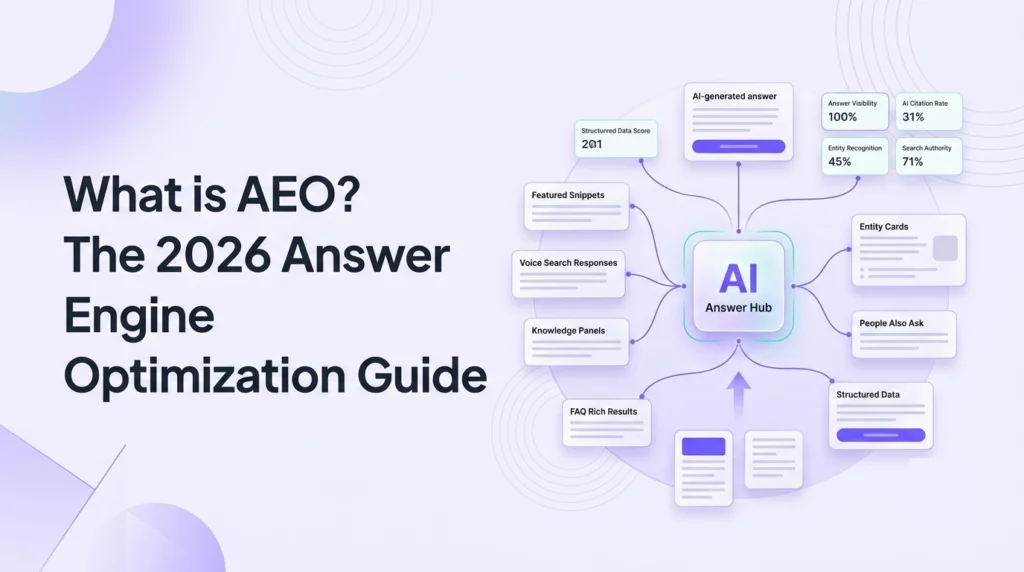
Answer Engine Optimization is the practice of structuring your content so that AI-powered platforms like Large Language Models (LLMs) such as ChatGPT, Google AI Overviews (formerly SGE), Microsoft Copilot, Perplexity, and voice assistants can easily extract it and deliver it as a direct answer to a user’s question.
Traditional SEO gets you ranked. AEO gets you cited.
That is a meaningful difference. When someone asks ChatGPT “what is the best CRM for small businesses,” they do not see a list of blue links. They see a confident, synthesized answer. If your brand is in that answer, you win visibility. If you are not, you simply do not exist in that moment and no matter how well your site ranks on page one.
Think of it this way: SEO puts you in the library. Answer Engine Optimization makes you the librarian.
Why Answer Engine Optimization Matters More Than Ever in 2026
The numbers behind the rise of zero-click searches are hard to ignore.
Zero-click searches have climbed from 56% of all Google searches in 2024 to 69% in 2025, according to industry research. That means nearly 7 out of every 10 searches on Google now end without a single click to any website.
At the same time, ChatGPT reached 800 million weekly active users by October 2025, according to OpenAI CEO Sam Altman. Google AI Overviews now appear in roughly 30% of all searches and in 74% of problem-solving queries.
Gartner also predicts that traditional search engine volume will drop 25% by 2026 as users increasingly shift to AI chatbots and virtual agents. This is not a future scenario. It is already happening.
Brands optimized for AI answers appeared in 18% of relevant AI-generated responses, while non-optimized brands appeared in just 3%, according to a BrightEdge analysis of 500,000 queries. If that gap does not make you slightly nervous, read it again.
AEO vs SEO: Understanding the Real Difference
This is where most people get confused. AEO and SEO are not rivals. They are teammates playing different positions.
SEO builds the infrastructure site speed, crawlability, backlinks, keyword targeting. AEO builds the clarity that helps Natural Language Processing (NLP) models understand and trust what you have built.
Here is the key distinction:
- Traditional SEO optimizes for crawl-index-rank pipelines driven by backlinks and keyword density.
- Answer Engine Optimization optimizes for Retrieval-Augmented Generation (RAG) pipelines that power how AI models extract and deliver answers.
- SEO values keyword relevance. AEO values factual density, structured answer blocks, and content freshness.
Still, they depend on each other. AI models use Google’s search index via real-time web search when generating answers. If your content is not indexed by Google, it is unlikely to appear in ChatGPT responses. Strong SEO directly feeds AEO visibility. You cannot skip SEO to do AEO. You need both.
How AI Search Works (And Why It Changes Everything)
To master Answer Engine Optimization, you first need to understand how AI search works at a basic level.
When a user asks an AI engine a question, the model does not just pull from a static database. It breaks the question into smaller sub-queries, searches the web in real-time, retrieves content from multiple credible sources, synthesizes a response, and critically decides which sources to cite.
That citation decision is what AEO Services are specifically built to target.
AI systems evaluate content based on several factors: Is the answer clearly structured? Is it factually accurate and backed by sources? Is the author or brand a recognized entity in the Knowledge Graph? Content formatted specifically for LLM extraction is 3 times more likely to be cited.
Your Practical AEO Guide: 6 Steps to Optimize for AI Answers
1. Answer Questions Directly at the Top
AI models extract answers from the first paragraph under a relevant heading. Stop burying your point. If a heading asks What is AEO? the very next sentence should define it cleanly and concisely. Pages with heading-level prompt alignment achieve much higher citation rates.
2. Use Structured Data and Schema Markup
FAQ Page JSON-LD schema drives 3.1 times higher answer extraction rates. Adding structured markup signals to AI systems exactly what your content is about. Furthermore, Organization schema and Local Business markup help build your Entity SEO, helping AI understand who you are, not just what you wrote.
3. Keep Answer Blocks Under 40 Words
AI extracts answers under 40 words at 2.7 times the rate of longer passages. This does not mean your full article should be short. It means your direct response to a specific question should be tight and punchy. Write a sharp answer first, then expand with context.
4. Back Every Claim with a Source
This is a core AEO signal. When you write “according to Gartner’s 2026 forecast” instead of just stating a number, AI systems recognize the credibility signal. Verified, attributed claims are cited at significantly higher rates.
5. Maintain Entity Consistency Across All Channels
If your brand description says one thing on your website, something slightly different on LinkedIn, and something else entirely on a third-party review site, AI systems lose trust. Consistent cross-source information is one of the simplest and most overlooked AEO wins available.
6. Build E-E-A-T Signals
Google’s E-E-A-T framework includes Experience, Expertise, Authoritativeness, and Trustworthiness and directly influences how AI evaluates content. Adding author bylines with credentials, including original research, and providing credible source citations can increase the likelihood of your content being referenced and cited.
AI Answer Boxes: What They Are and How to Win Them
AI answer boxes (like Google AI Overviews) are the direct-response panels you see at the top of search results. They are the prime real estate of modern search.
Google AI Overviews appear in approximately 91.3% of informational queries, per Semrush’s analysis of over 10 million keywords Winning these requires clear structure, credible sources, schema markup, and concise answer blocks.
One amazing benefit: Visitors arriving through AI search convert at 4.4 times the rate of those from traditional organic search. You may get fewer raw clicks, but the traffic is highly targeted. Quality over quantity.
The Future of SEO and Answer Engine Optimization
The future is not a competition between the two. It is a merger. By 2026, the smartest brands practice Hybrid Optimization using SEO to build site authority, and then applying Answer Engine Optimization to ensure that authority translates into AI citations.
Voice search is also accelerating this shift. Voice assistants deliver single spoken answers, not ranked lists. If you are not that one answer, you are simply not heard.
Optimize for AI Answers: Where to Start Today
If you are just getting started, here is your checklist:
- Audit your most important pages for clear question-answer structure.
- Add FAQ Page schema to your key landing pages.
- Ensure your brand description is consistent across your website and social profiles.
- Add author credentials and external source links to your content.
- Refresh high-value pages every 90 days to maintain content freshness.
Generative Engine Optimization (GEO) vs AEO: Are They the Same?
This question comes up a lot, and honestly, the industry has not fully settled it yet.
GEO (Generative Engine Optimization) is a broader term that encompasses AEO plus additional strategies like AI visibility monitoring, cross-platform citation management, and brand entity optimization. Think of AEO as a subset of GEO, one focused specifically on AI answer extraction.
In practice, most Geo services include AEO techniques as core components. If you are exploring both, starting with solid AEO fundamentals will set you up for broader GEO success as the landscape continues to evolve.
Final Word: The Shift Has Happened
Answer Engine Optimization is not replacing SEO. But it is becoming just as important—and in some industries, it is already more important.
The shift has happened. Because in 2026, being found on page one is no longer enough. You need to be the answer.
Frequently Asked Questions
Does Answer Engine Optimization replace traditional SEO?
No. Answer Engine Optimization relies heavily on traditional SEO. SEO builds the technical foundation, crawlability, and site authority, while AEO formats the content so that Large Language Models (LLMs) can easily extract and cite it as an answer.
How do I get my website cited by ChatGPT and AI Overviews?
To get cited by AI engines, ensure your content is indexed by Google (or Bing for Copilot). Maintain high factual density, include specific data points with external sources, and provide direct, concise answers (under 40 words) directly beneath your H2 or H3 headings.
What is the difference between AEO and GEO?
AEO (Answer Engine Optimization) focuses specifically on structuring your on-page content so AI bots can extract it for direct answers. GEO (Generative Engine Optimization) is a much broader concept that includes AEO but also involves cross-platform reputation management and overall brand entity optimization.