
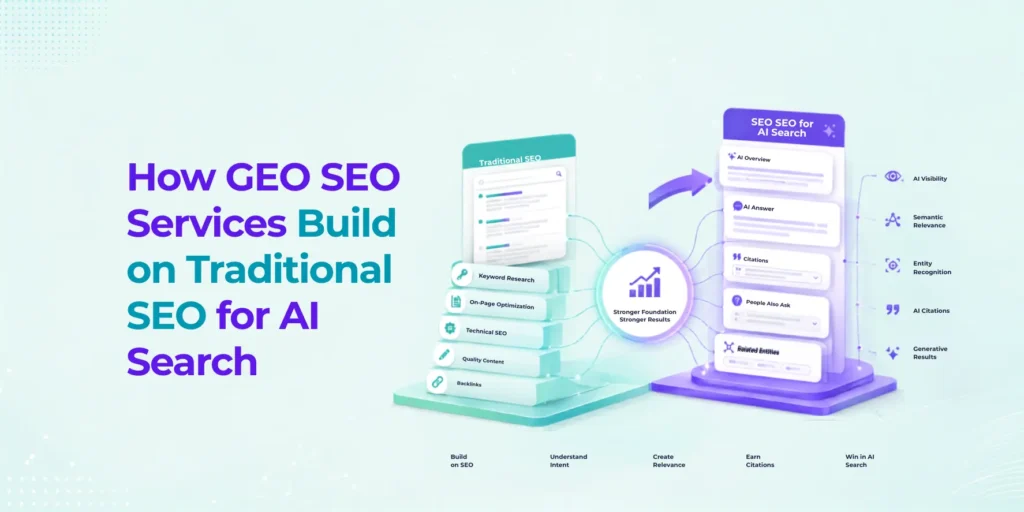
GEO SEO services extend traditional search engine optimization in order to assist content in getting pulled into AI-generated answers from tools such as Claude AI, Perplexity, ChatGPT, and Google AI Overviews. Instead of swapping SEO fundamentals, generative engine optimization builds straight on top of them, layering structured information, entity clarity, and trust signals onto the technical and content foundation traditional SEO already established.
Marketing teams keep asking a version of the same question lately: does AI search mean starting over? The honest answer, based on what’s actually working over live implementations, is absolutely not. GEO SEO services don’t reject the last two decades of search optimization; they add an additional layer created for a diverse kind of reader: a language model summarizing and synthesizing content instead of a crawler ranking it.
This piece walks through exactly how that layering works, where traditional SEO still carries the load, and what a GEO-focused provider actually does differently once the foundation is in place.
What is GEO (Generative Engine Optimization)?
Generative engine optimization services focus on making content legible, citable, and trustworthy to AI systems that generate summarized answers rather than simple ranked lists. The term covers a range of technical and content work aimed at influencing whether a brand gets quoted, paraphrased, or linked inside an AI-written response.
How GEO Differs From Traditional SEO
Traditional SEO measures success through rankings and organic click-through. GEO measures success through citation frequency inside generated answers, often without a click at all. That distinction changes what “winning” looks like: a page can perform well under GEO metrics while seeing flat or declining traditional traffic, because the value now shows up as brand exposure inside an AI answer rather than a visit to the site.
Why AI Search Needs a New Optimization Approach
The way search engines historically ranked is the same way language models don’t crawl and get ranked. What they do is synthesize, retrieve, and generate, which means content needs to be structured for extraction instead of just being relevant. A page stuffed with keywords but light on clear, self-contained statements is much harder for a model to lift cleanly into a summary, even if that similar page would have ranked well under past algorithms.
What Do Traditional SEO Services Cover?
Core Traditional SEO Foundations (Technical SEO, Content, Links)
Traditional SEO services still anchor almost everything downstream. Technical SEO covers site crawlability, mobile usability, speed, and indexing health. Content strategy covers keyword research, topical coverage, and on-page optimization. Link building builds domain authority via digital PR, as well as earned backlinks. Without these fundamentals in solid shape, no amount of AI-specific layering will establish reliable outcomes, because AI systems still depend on the same underlying web infrastructure to find and examine content.
We’ve observed over hundreds of site audits that businesses omitting straight-to-GEO tactics without a secure technical foundation tend to experience inconsistent outcomes. A slow-loading page, a poorly structured sitemap, or thin content thrown together purely to hit a word count still causes issues for AI crawlers in a similar way it hurt traditional rankings years ago. If anything, the bar has gotten higher, since AI systems are more selective about which sources they treat as trustworthy enough to cite by name.
Why Traditional SEO Alone Isn’t Enough for AI Search
A technically sound, well-ranked page can still get skipped by an AI Overview if it lacks a direct answer near the top, proper schema, or clear authorship signals. Traditional SEO gets a page discovered and trusted by search engines. It doesn’t automatically make that page quotable by a model generating a two-sentence summary for a user who never scrolls past the answer box.
How GEO SEO Services Build on Traditional SEO
Structured Data and Schema Markup as a Foundation
GEO work normally begins by expanding, and auditing whatever schema markup is already present from prior SEO efforts. Article schema, FAQ schema, and organization schema that were originally implemented for search engine clarity now do double duty, providing AI systems the same structured signals they require to accurately attribute and summarize content.
Extending Semantic SEO and Entity Optimization
Traditional SEO already pushed the industry toward topic clusters and semantic keyword coverage over the last several years. GEO pushes that further into explicit entity relationships, guaranteeing a brand, its products, and its area of expertise are unambiguously linked over the site and, ideally, over third-party sources such as Wikipedia, industry directories, and press coverage that AI models draw on for corroboration.
Adding AI-Specific Content Structuring
This is where GEO diverges most visibly from legacy SEO practice. Content gets restructured so a direct, quotable answer appears within the first few sentences of a section, followed by supporting detail for readers who want depth. In our practical testing, this restructuring alone, without any new content being added, has moved previously ignored pages into AI Overview citations within weeks.
Layering E-E-A-T Signals for AI Trust
Experience, expertise, authoritativeness, and trust signals hold more importance than GEO, not less. AI systems weigh publication history, author credentials, and citation-worthy sourcing heavily when planning what should be surfaced. Field data over implementations shows that pages with visible author bios and cited original information get referenced by AI tools at meaningfully greater rates than anonymous or entirely promotional content.
| Layer | Traditional SEO Role | GEO Extension |
| Technical foundation | Site speed, crawlability, indexing | Ensures AI crawlers can access and parse content reliably |
| Schema markup | Optional enhancement for rich snippets | Core requirement for AI entity recognition and citation |
| Content structure | Keyword-optimized long-form articles | Direct-answer summaries paired with supporting depth |
| Authority signals | Backlinks and domain authority | E-E-A-T signals, author credentials, third-party corroboration |
| Success metric | Rankings and organic traffic | AI citation frequency and brand mention share |
Traditional SEO vs. GEO SEO — Key Differences
| Factor | Traditional SEO | GEO SEO |
| Target system | Search engine ranking algorithms | Generative AI models and answer engines |
| Primary output | Ranked list of links | Synthesized, often single-source answer |
| Content format priority | Comprehensive long-form coverage | Extractable, self-contained statements |
| Timeline to results | Weeks to months for ranking movement | Faster snippet-level gains, citation trust builds over time |
| Measurement tools | Rank trackers, analytics platforms | AI citation monitoring, brand mention tracking |
How AI Search Engines Rank Content
Google AI Overviews
Google’s generative results draw heavily from pages that already rank well organically, layered with a preference for content that answers the query directly near the top of the page. Sites with powerful existing SEO performance have a real head start here, since AI Overviews often pull from the similar pool of high-authority pages Google already trusts.
ChatGPT and Perplexity AI
These tools browse live sources when answering, weighting recency, clarity, and source credibility. Perplexity in particular tends to cite many sources per answer, which means ranking well isn’t winner-take-all the way a single AI Overview citation can be; there’s more room for several credible sources to appear together.
Bing Copilot
Copilot pulls from the Bing index and displays a visible pattern of favoring pages with clean structured data and clear topical focus, similar to Google’s strategy but with its own weighting toward Microsoft’s existing search infrastructure and partner content relationships.
How GEO and AEO Work Together
GEO and AEO overlap heavily and are often used interchangeably, though AEO leans slightly more toward direct question-and-answer formatting while GEO covers the broader technical and semantic layer across an entire content ecosystem. In practice, most agencies bundle both under a single retainer because the underlying technical work, schema, entity clarity, and structured content, serve both goals simultaneously.
Who Needs GEO SEO Services?
Businesses already investing with seriousness in SEO content are the best candidates, since GEO amplifies an existing base instead of replacing it. All the publishers, financial service firms, SaaS companies, and healthcare organizations tend to experience the fastest returns, given how heavily their audiences depend on research-driven problems that AI tools are increasingly built to answer directly.
E-commerce brands are a slightly different case. Product comparison content, buying guides, and how-to articles get pulled into AI summaries frequently, but individual product listing pages rarely do, since AI tools tend to favor editorial-style content over transactional pages. Local and service-area businesses see more limited GEO benefit today, though that’s changing quickly as AI Overviews expand further into local and near-me style queries, so it’s worth revisiting this assessment on a regular cadence rather than treating it as settled.
How to Choose a GEO SEO Agency
A capable GEO SEO agency should be able to show you specific examples of client content that’s been cited inside AI overviews or chatbot responses, not just theoretical strategy decks. Ask how they measure success beyond traditional rankings, since a provider still reporting only on keyword position hasn’t fully adapted their measurement framework to what GEO actually requires.
Getting Started with Professional GEO Services
Most businesses starting fresh should expect an initial audit phase comparing current AI visibility against traditional search performance before any new content work begins. When evaluating GEO services, ask providers directly how their approach integrates with, rather than duplicates, any existing SEO retainer you’re already paying for, since overlapping scope is one of the most common billing disputes in this space right now.
Final Verdict
The businesses adapting fastest to AI search aren’t the ones giving up on SEO, they’re the ones acknowledging that semantic clarity, well-structured data, and reliable authority were always the foundation, and generative engines just increased the stakes on getting those fundamentals right. GEO isn’t a replacement approach. It’s what traditional SEO becomes once the reader on the other end is a model instead of a person scrolling a results page.
Frequently Asked Questions
1. What is the difference between GEO and traditional SEO?
The difference between these two is that traditional SEO optimizes for ranking position on search results pages, while GEO optimizes for being cited or summarized straight inside AI-generated answers.
2. Can traditional SEO alone rank in AI search?
Traditional SEO assists content in getting discovered and believed, but without direct-answer formatting and schema markup, pages often get skipped by AI-generated summaries even when they are ranking well.
3. Which businesses need GEO SEO services?
Research-heavy industries like finance, SaaS, publishing, finance, and healthcare look at the most powerful returns, especially businesses already investing in robust SEO content.
4. What are the benefits of GEO SEO services?
Benefits include higher visibility inside AI overviews and chatbot answers, stronger brand experience even without clicks, and a content structure that boosts both traditional and AI search performance.
5. What is the difference between GEO and AEO?
GEO covers the wider technical and semantic optimization layer for AI search, while AEO concentrates more particularly on question-and-answer content formatting, with the two overlapping significantly.
6. How do GEO and AEO work together?
These two rely on similar underlying technical work, schema markup, well-structured content, and entity clarity, so many providers deliver them together under an individual strategy.