
Here is something worth saying out loud. The UAE is number one in the world for AI adoption in 2026. Not in the region. In the world. According to Microsoft’s January 2026 AI Diffusion Report, over 64% of the UAE’s working-age population now actively uses generative AI tools. That number puts the country ahead of Singapore, Norway, and every major Western economy.
So when we talk about AI search optimization for UAE businesses, we are not talking about a future trend. We are talking about your customers, right now, asking ChatGPT what to buy, asking Perplexity which agency to hire, and getting answers from Google’s AI Overviews before they ever click a link.
Two strategies sit at the center of this shift: Generative Engine Optimization (GEO) and Answer Engine Optimization (AEO). Both are real. Both matter. And they are not the same thing. Getting clear on the difference could be one of the most commercially useful things you do this year.
What Is AEO? And Why UAE Businesses Cannot Ignore It
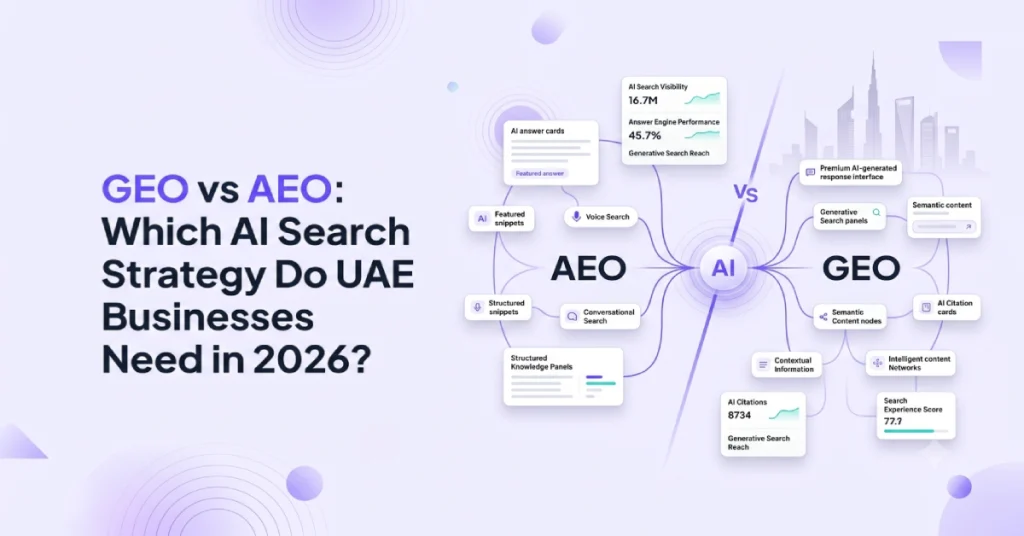
Answer Engine Optimization is the practice of structuring your content so that AI-powered search platforms extract and deliver it as a direct answer to a user’s question. Think Google AI Overviews, Microsoft Copilot, voice assistants, and featured snippets.
When someone in Dubai asks their phone “which accounting firms in Abu Dhabi offer VAT consulting,” and an answer comes back instantly without a single click, that answer came from somewhere. AEO is the work that puts your brand in that position.
The numbers make the urgency clear. According to Gartner, by Q4 2026, AI-powered answer engines will influence 60% of all commercial research queries globally, up from 40% in early 2025. Meanwhile, Ahrefs data cited in Jasper’s 2026 GEO report shows that AI Overviews have already cut click-through rates for top-ranking Google content by 58%. Businesses that rank but do not appear in AI answers are losing visibility fast.
AEO strategy for business growth is built on precision. Short, factual answer blocks. FAQ schema markup. Clear heading hierarchies. Content that answers real questions directly, ideally within 40 to 60 words per block, as recommended by leading AEO practitioners in 2026.
What Is GEO? The Strategy Your Competitors Have Not Figured Out Yet
Generative Engine Optimization is broader and frankly more complex. It focuses on making your brand a cited source inside the longer, research-style outputs that large language models produce on platforms like ChatGPT, Perplexity, Gemini, and Claude.
AEO gets you into the quick answer layer. GEO gets you referenced in the researched response layer. The difference matters because people using AI for purchase decisions, vendor comparisons, or industry research are spending much more time in the GEO layer than the AEO layer.
The foundational research here comes from Princeton and Georgia Tech’s landmark GEO study, conducted with 10,000 queries. Their findings are specific and actionable: adding expert quotes to content improves AI citation visibility by approximately 41%. Adding statistics improves it by around 30%. Adding inline citations improves it by another 30%. These are not soft signals. They are measurable levers that GEO optimization techniques are built around.
For UAE businesses in B2B, professional services, real estate, and finance, GEO is the equivalent of earning editorial coverage in a publication your audience trusts. Except the publication is the AI system your buyer uses every morning.
GEO vs AEO: The Differences That Actually Change Your Strategy
Both strategies involve optimizing for AI. Both require quality content. But they work differently, target different platforms, and produce different business outcomes. Here is where the distinction becomes practical.
What They Each Target
AEO targets the extraction moment. A user asks a specific question. The AI pulls your pre-written answer. GEO targets the synthesis moment. A user asks for a recommendation, comparison, or explanation. The AI builds its response from multiple sources and yours is one of them.
Which Platforms They Cover
AEO is most effective for Google AI Overviews, Microsoft Copilot, voice search, and featured snippets. GEO optimization techniques focus on ChatGPT, Perplexity, Gemini, and Claude, where users engage in longer, more exploratory conversations. According to TechCrunch’s February 2026 report, ChatGPT now has over 900 million weekly active users globally. Perplexity processes 780 million search queries per month, up from 230 million in August 2024. These are not niche tools. They are mainstream search.
Content Format and Approach
AEO demands structured, schema-optimized content formatted for direct extraction. GEO rewards comprehensive, well-cited, authoritative content that reads like a trusted industry source. AEO is a briefing card. GEO is the white paper that gets cited in the briefing card.
Speed to Results
AEO can show results within weeks if your content already holds decent organic positions. A 2026 analysis from Surmado notes that 92% of domains cited in Google AI Overviews already rank in the traditional top 10 organic results. GEO is a longer investment, typically three to six months, but it builds compounding authority that gets harder for competitors to displace.
If your goal is to appear when buyers ask AI systems direct questions about your service category, building a structured AEO agency UAE strategy with Seoliono is where that process starts.
Which Strategy Should UAE Businesses Prioritize Right Now?
The real answer is both, but the starting point depends on your business model and where your buyers spend their attention.
If you run a local service business, a retail brand, or any company where customers ask direct questions before buying, AEO is your first priority. You want to be the answer when someone in Dubai asks for the best options in your category.
If you are a B2B company, a consultant, a professional service provider, or a brand trying to build category authority, GEO is where you should put serious resources. Being referenced by ChatGPT or Perplexity in a considered research response is the new version of a trusted industry recommendation.
For enterprises competing across multiple verticals in the UAE, the Stanford HAI AI Index 2026 confirmed that the UAE outperforms its GDP per capita peers in AI adoption, sitting among the global leaders in both consumer and enterprise AI use. Your buyers are not just aware of AI search tools. They use them daily, for work and personal decisions. Running GEO and AEO in parallel is not a luxury in this market. It is the baseline.
How to Optimize Content for AI Search Engines: What Actually Works in 2026
Whether your focus is GEO, AEO, or both, these are the content approaches that deliver results based on current platform behavior and published research.
- Structure content around real user questions. Map your content to the actual prompts your audience types into ChatGPT or speaks into voice search. This is not keyword research. It is intent modeling.
- Use the 40-word answer block rule. Research from Gen Optima’s Q1 2026 analysis shows that AI systems extract answers under 40 words at 2.7 times the rate of longer passages. Write a tight, direct answer at the top of every section.
- Cite real data and name your sources inline. The Princeton GEO study confirmed that statistical density and visible citations are among the strongest signals for LLM citation probability. Do not bury your sources in footnotes.
- Deploy FAQ schema and structured data. FAQ schema pages show disproportionately higher AI citation rates across multiple verticals, according to 2026 content analysis by Marketing LTB. Schema is no longer optional for serious AI visibility.
- Build your E-E-A-T signals consistently. Google’s Quality Rater Guidelines and the LLMs that pull from indexed content both reward Experience, Expertise, Authoritativeness, and Trustworthiness. These signals need to show up on-page and across third-party mentions.
- Maintain cross-platform consistency. Gen Optima’s research found that brands referenced by 10 or more independent domains achieve 3.2 times higher AI mention rates than those with fewer external citations. Digital PR and earned coverage directly support GEO outcomes.
The UAE Context: Why This Is More Urgent Here Than Almost Anywhere
The UAE does not just lead the region in AI adoption. It leads the world. A Cyber news analysis using Google Play and Apple App Store download data across 64 countries ranked the UAE, Singapore, and Chile as the top three nations for consumer AI app adoption globally.
A separate Microsoft AI Diffusion Report published in January 2026 recorded over 64% of the UAE’s working population using generative AI tools, a figure that outpaces even highly digitized economies like the US (28.3%) and most of Western Europe. Dubai specifically ranked in the global top five for city-level AI adoption, ahead of San Francisco, according to Counterpoint Research.
What this means practically is that your target audience in the UAE is far more likely than consumers in most markets to ask an AI system for a vendor recommendation before they search Google. AI search optimization for UAE businesses is not a forward play. It is a competitive necessity in the market you are operating in today.
Seoliono offers dedicated GEO Services in Dubai built specifically for UAE businesses that want to earn consistent visibility inside AI-generated search responses across ChatGPT, Perplexity, Gemini, and Google AI Overviews.
Three Mistakes UAE Businesses Make with AI Search Strategy
Watching how businesses approach this space, the same patterns keep showing up.
The first mistake is treating GEO and AEO as the same thing and writing generic content that does neither well. AEO needs tight structure and schema. GEO needs depth, citations, and topical authority. Trying to do both without a clear strategy produces content that gets ignored by both.
The second mistake is ignoring structured data completely. Many UAE business websites still have no schema markup. According to 2026 AEO data from Gen Optima, FAQ schema alone drives 3.1 times higher answer extraction rates. That gap is too large to leave unclosed.
The third mistake is producing AI-generated content at scale without adding genuine human expertise on top. A 2026 analysis reported that 100% of sites that received manual Google penalties in the March 2024 update action used AI-generated content without meaningful human input. The Conductor 2026 AEO and GEO Benchmarks Report put it directly: the brands winning AI search are those building holistic visibility, not chasing individual engine tactics.
How Seoliono Builds AI Search Visibility for UAE Clients
At Seoliono, the approach to GEO vs AEO AI search strategy starts with where your brand actually stands inside AI-generated responses, not just where you rank on a traditional SERP.
Every engagement begins with an AI visibility audit across the major platforms your audience uses. From there, the team builds a content architecture that serves both GEO and AEO goals simultaneously, calibrated to your industry, buyer profile, and growth stage in the UAE market.
The result is not just better rankings. It is your brand being cited, recommended, and referenced by the AI systems your customers trust. In a market where 64% of the working population uses AI tools daily, that kind of visibility is the new competitive moat.
If that is the position you want to build, the conversation starts here.
Conclusion
GEO and AEO are not interchangeable terms and they are not the same strategy. AEO puts you in the direct answer. GEO puts you in the trusted reference. In the UAE, where AI adoption leads the world, businesses that understand both and execute on both will pull away from competitors who are still focused on keyword rankings alone.
The data from 2026 is clear. AI search platforms are not a rising trend. They are the primary discovery layer for an increasing share of commercial queries. The businesses that build real authority inside these systems, structured content, cited data, consistent brand presence, and genuine expertise, will compound their advantage over time in ways that traditional SEO simply cannot replicate.
The question is not whether to invest in AI search optimization. In the UAE market in 2026, that decision has already been made for you by your customers.