
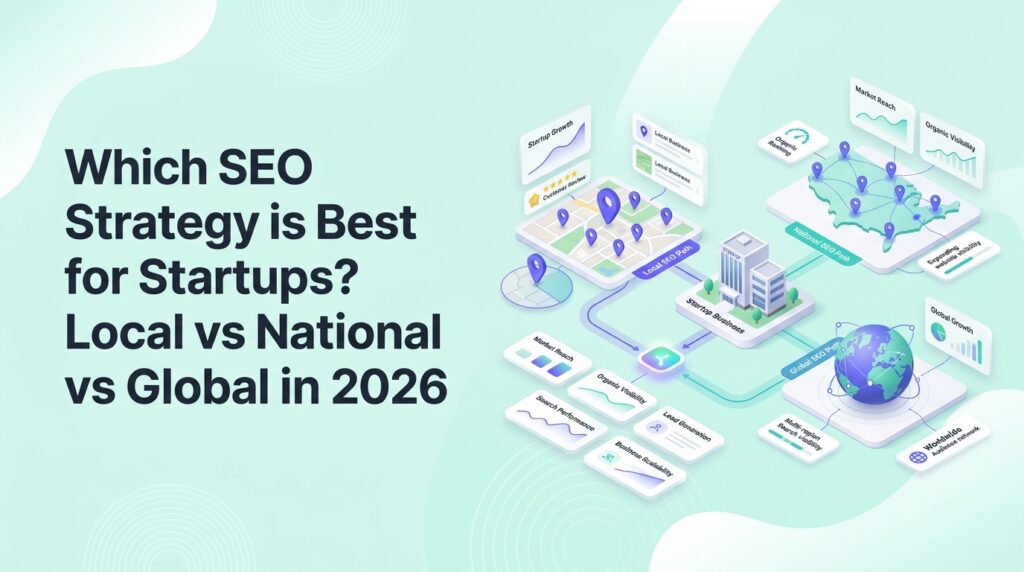
The best SEO strategy for startups depends entirely on where your customers are located. If you serve a single city or region, local SEO is the right starting point. If you sell nationwide with no location dependency, a national SEO strategy makes more sense. If you already have (or plan) customers in multiple countries, a global SEO strategy, built on hreflang tags and localized content, is worth the investment. Most startups should start local or national, then expand as revenue and market data justify it.
Choosing the right SEO strategy for startups isn’t easy when budgets and time are limited. This guide compares local, national, and global SEO to help you choose the best.
Why SEO Strategy Matters for Startups in 2026
How SEO Impacts Early-Stage Growth
For most startups, SEO is the only marketing channel that keeps compounding after the initial investment stops. Unlike paid ads, which stop generating traffic the moment the budget runs out, organic rankings built early can continue driving qualified traffic for years. In our experience working with early-stage companies, founders who invest in SEO within their first 12 months typically see meaningfully lower customer acquisition costs by year two, compared to those relying solely on paid channels.
The catch is that SEO takes time to compound, usually 4 to 9 months before rankings stabilize. That means the strategy you choose now determines what kind of traffic you’ll be capturing when that payoff finally arrives.
Few Mistakes Startups Make When Choosing an SEO Strategy
The most frequent error isn’t a lack of effort, it’s misalignment between strategy and actual business reality.
- Going national too early, before there’s enough content or authority to compete for broad, high-competition keywords.
- Ignoring local SEO even when the business has a physical or service-area component, missing high-intent “near me” searches entirely.
- Jumping to global SEO based on aspiration rather than any confirmed international demand.
- Splitting content thin across too many markets at once instead of dominating one segment first.
What is Local SEO for Startups?
Local SEO for startups focuses on ranking within a specific city, region, or service area, primarily through Google Business Profile optimization, local citations, and location-specific content.
When Local SEO Makes Sense for a New Business
Local SEO is the right starting point when your startup depends on physical proximity to customers, a clinic, a home services company, a boutique retail store, or any business fulfilling orders within a defined delivery radius. If most of your revenue depends on someone finding you nearby, this is where your SEO budget should go first.
Key Local SEO Tactics (Google Business Profile, Local Citations, Reviews)
- Optimize your Google Business Profile with accurate categories, hours, and regularly updated photos.
- Build local citations across directories like Yelp, industry-specific listings, and local chambers of commerce.
- Actively collect and respond to reviews — review volume and recency both influence local pack rankings.
- Create location-specific landing pages if you serve multiple nearby cities or neighborhoods.
Many early-stage founders don’t have the bandwidth to manage citations, review generation, and Google Business Profile updates alongside actually running the business, which is why it’s common to bring in a local SEO agency to handle the operational side while the founder focuses on product and sales.
What is a National SEO Strategy?
A national SEO strategy targets keyword rankings across an entire country, without geographic restriction, and typically relies on broader content strategy and domain authority building rather than local citations.
When Startups Should Consider National SEO
This approach fits SaaS companies, e-commerce brands shipping nationwide, and any digital-first startup where the buyer’s location doesn’t affect the transaction. If you’re comparing local vs national SEO for a business with no physical storefront and no service-area restriction, national is almost always the better fit.
Key National SEO Tactics
- Build topical authority through comprehensive content clusters around your core product category.
- Invest in backlink acquisition from national publications and industry sites, since domain authority matters more at this scale.
- Target higher-volume, more competitive keywords than local SEO typically requires.
- Ensure technical SEO fundamentals (site speed, mobile usability, structured data) are solid, since national competition is steeper.
What is a Global SEO Strategy?
A global SEO strategy extends your SEO efforts across multiple countries and, often, multiple languages, requiring technical infrastructure like hreflang tags in addition to content strategy.
When Startups Should Consider Global or International SEO
Global or international SEO should typically wait until you have measurable organic or paid traffic already arriving from international markets, or a clear strategic reason (like an international funding round or a partnership) to enter a specific country. Building out global infrastructure before that demand exists is one of the most common ways startups waste an early SEO budget.
Key Global SEO Tactics (Hreflang, Multi-Region Content, Localization)
- Implement hreflang tags correctly so search engines serve the right language/region version of your pages to the right users.
- Localize content, not just translate it — currency, idioms, and even product framing often need to shift by market.
- Set up region-specific technical infrastructure, such as country-code domains or subdirectories (e.g., /uk/, /de/).
- Research keyword intent locally — the same product can be searched completely differently across markets, even in the same language.
Local vs National vs Global SEO — Side-by-Side Comparison
| Factor | Local SEO | National SEO | Global SEO |
| Target Audience | Customers in a specific city/region | Customers across one country | Customers across multiple countries |
| Keyword Focus | Location-modified, “near me” terms | Broad, high-volume national terms | Localized terms per market/language |
| Content Strategy | Location pages, local guides | Topical authority clusters | Region-specific, localized content |
| Technical Requirements | Google Business Profile, schema markup | Strong site architecture, backlinks | Hreflang, multi-region infrastructure |
| Budget & Resources | Lower — manageable for small teams | Medium to high — more competitive | High — content + technical + localization |
| Best For | Service-area or brick-and-mortar startups | Nationwide SaaS/e-commerce startups | Startups with proven international demand |
How to Choose the Right SEO Strategy for Your Startup
Assess Your Target Market
Start with where your paying customers actually are today, not where your ambitions point. Pull data from your existing analytics, CRM, or even informal customer conversations to see the real geographic spread of demand.
Evaluate Your Business Growth Stage
A pre-revenue or early-revenue startup rarely has the content and backlink resources to compete nationally right away. Matching your SEO strategy for startups to your actual growth stage, not your funding round headlines, keeps early efforts realistic and effective.
Consider Budget and Available Resources
Local SEO can often be managed with a modest monthly budget and part-time effort. National and global strategies require sustained investment in content production, technical SEO, and link building, underfunding these halfway through is worse than not starting at all.
Align SEO Strategy with Business Goals
If your 12-month goal is dominating a single metro market before a Series A raise, local SEO wins. If your goal is nationwide within the same window, national SEO deserves the larger share of the budget. Whichever direction you choose, it should map directly to the goals in your actual business plan, not a generic best-practices checklist.
For startups without an in-house SEO hire, this is usually the point where it makes sense to bring in dedicated SEO services, an outside team can build out the technical foundation and content strategy faster than most early hires could alone, and can help avoid the trial-and-error period that slows down DIY efforts.
Signs You Need to Upgrade Your SEO Strategy
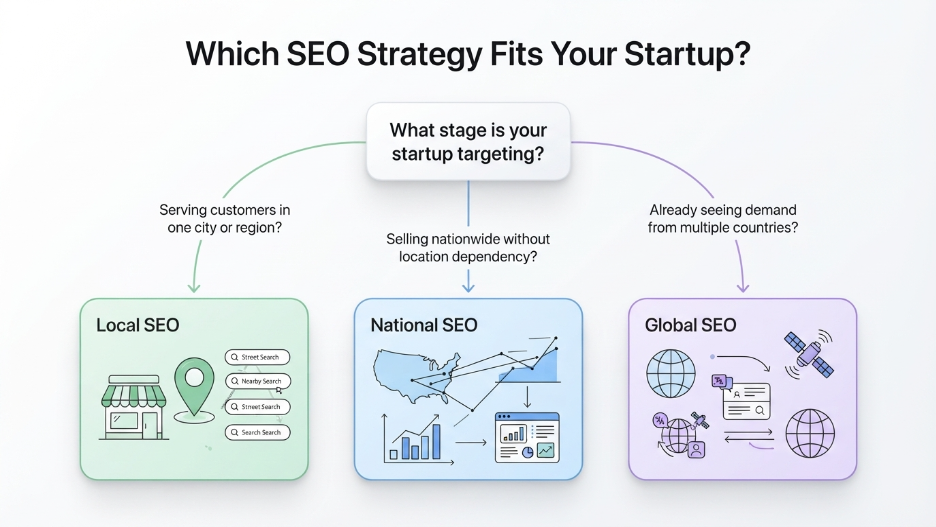
Signs You’ve Outgrown Local SEO
- You’re ranking well locally but hitting a revenue ceiling tied to market size.
- A meaningful share of inquiries are already coming from outside your original service area.
- You’ve expanded product or service delivery beyond your original geography.
Signs You’re Ready for National Expansion
- You have consistent organic traffic and conversions from your core local market.
- Your content and backlink profile have reached a level competitive within your niche.
- Your fulfillment, support, or delivery infrastructure can already handle nationwide customers.
Signs You’re Ready for Global Markets
- You’re already seeing meaningful organic or referral traffic from other countries.
- You have the operational capacity (support, payments, shipping/compliance) to serve international customers.
- A specific market has shown demand through inbound signups, waitlists, or partnership interest.
4 SEO Mistakes Startups Make at Each Stage
- At the local stage: neglecting Google Business Profile updates and letting reviews go unanswered.
- At the national stage: publishing broad content without enough depth to outrank established competitors.
- At the global stage: using machine-translated content instead of proper localization, which damages trust and rankings alike.
- At every stage: treating SEO as a one-time project instead of an ongoing, iterative process tied to real performance data.
End Note
There’s no single best SEO strategy for startups, only the strategy that matches where your customers currently are and where your business is realistically headed next. Most startups are best served starting with local or national SEO, then expanding into global markets only once real demand data supports it. Reassess your strategy every two to three quarters as your growth stage changes, rather than locking into one approach indefinitely.
Frequently Asked Questions (FAQs)
1. Which SEO strategy is best for startups?
It depends on your customer base: local SEO suits startups tied to a physical location or service area, national SEO fits startups selling countrywide, and global SEO fits startups with confirmed international demand.
2. Should a startup choose local or national SEO?
Choose local if your business depends on proximity to customers; choose national if your product or service has no geographic restriction and you’re targeting an entire country.
3. When should a startup invest in global SEO?
Invest in global SEO once you have measurable traffic or demand from international markets, or a clear strategic reason like an international expansion plan already underway.
4. What is the difference between local, national, and global SEO?
Local SEO targets a specific city or region, national SEO targets an entire country, and global SEO targets multiple countries, each requiring different keyword, content, and technical approaches.
5. How do I choose the right SEO strategy for my startup?
Assess where your current customers are located, your growth stage, and your available budget, then align your SEO strategy with your actual 12-month business goals rather than long-term ambitions.
6. Is local SEO enough for a new startup?
For most brick-and-mortar or service-area startups, yes, local SEO alone can drive meaningful growth in the first year before national or global expansion becomes relevant.