
AEO for ecommerce is the practice of structuring product pages, reviews, and store data so AI systems such as Google AI Overviews, ChatGPT, and Perplexity can read, trust, and recommend your products inside a generated answer. Instead of chasing a ranking position on a results page, it focuses on becoming the product an AI assistant actually names when a shopper asks a buying question. Stores that get this right in 2026 are already capturing sales from searches that never produce a single traditional click.
A shopper asks ChatGPT for a good pair of waterproof hiking boots under a set budget. The assistant replies with three specific picks, complete with sizing notes and where to buy each one.
There is no results page to scroll and no ten blue links to compare. Just a direct answer, with real products already attached to it.
That shift is why AEO for ecommerce has moved from a niche experiment to something store owners cannot afford to ignore in 2026. This guide covers what it actually means, why it changes real sales numbers, and the concrete steps that get a store showing up inside AI-generated answers instead of getting skipped over.
What Is AEO for Ecommerce?
AEO for ecommerce means structuring a store’s product data, reviews, and content so AI systems can read, trust, and surface it directly inside a generated answer. It is a form of answer engine optimization for online stores, and it stretches further than schema markup alone. It touches how plainly a product description states its own facts.
The goal is simple to state and harder to execute. Every product page should hand an AI system a clean, factual sentence it can lift and quote with confidence, backed by structured data that confirms the same facts in a machine readable form.
This matters most at the exact moment a shopper is deciding between two or three options. An AI system that can quote your product page confidently will name your product in that comparison. One that cannot simply moves on to a competitor with clearer content.
How AEO Differs From Traditional Ecommerce SEO
Traditional SEO optimizes for a ranking position a human will click. AEO optimizes for being the answer an AI system gives, which means the content itself needs to be directly quotable, not just keyword rich.
Both disciplines still depend on genuine relevance and technical accessibility. But they measure success differently, and that difference changes how a content team should prioritize its work.
| Aspect | Traditional Ecommerce SEO | AEO for Ecommerce |
| Primary goal | Rank a product page in blue links | Get cited directly inside an AI-generated answer |
| Content shape | Keyword-optimized page copy | Clear, structured, directly quotable answers |
| Success signal | Click-through rate and ranking position | Citation or inclusion in the AI response itself |
| Data format | Human-readable text | Structured data plus human-readable text together |
| User journey | Search, click, browse, buy | Ask, get an answer, sometimes buy without a click |
How AI Search Is Changing Online Shopping
AI search for ecommerce is fundamentally changing where product discovery starts. A growing share of shoppers now open a chat window before they ever open a search engine tab.
Shopping Intent Queries in Conversational Search
Shoppers increasingly phrase searches as full questions rather than keyword fragments. These shopping intent queries expect a direct, specific answer back, not a list of links to sort through manually.
AI-Generated Search Results and Product Discovery
Product discovery often starts and ends inside a single AI conversation now. When AI-generated search results already include a specific product recommendation, the traditional browse and compare journey shortens dramatically, sometimes down to one exchange.
Why Ecommerce Brands Need AEO in 2026
Rising Use of AI Shopping Assistants
More shoppers now start product research inside an AI shopping search assistant instead of a traditional search engine. They treat it like a knowledgeable friend rather than a wall of results to filter through themselves.
Declining Clicks From Traditional Search Results
As AI-generated answers satisfy more queries directly, fewer searches produce a click to any website at all. This pattern is already visible across informational search, and it is extending into shopping queries too.
That shift is exactly why treating AI search for ecommerce as an afterthought is becoming a genuinely risky bet heading into 2026.
How AEO Improves Ecommerce Sales
The payoff of AEO is not just visibility for its own sake. Each of the gains below ties back to a measurable sales outcome, which is why it belongs on a growth roadmap rather than a purely technical checklist.
Increased Visibility in AI-Generated Answers
Being named directly inside an AI answer puts a product in front of a shopper at the exact moment of decision. It does not have to compete against nine other blue links for attention.
Higher-Intent Traffic From Conversational Queries
Shoppers who arrive after an AI recommendation already trust that recommendation. This tends to produce a shorter path to purchase than a cold click from a general search result.
Improved Trust Through Structured, Accurate Product Content
Clean, consistent, accurate product data does more than help AI systems find a store. It also reduces returns and support tickets from shoppers who ordered based on genuinely accurate information in the first place.
Reviews play a quiet but significant role here too. When ratings, review counts, and real customer language are visible and easy to read, both AI systems and human shoppers trust the page more. This is the less obvious payoff of ecommerce AI search optimization, and it rarely makes it into the sales pitch even though it shows up clearly in the numbers.
How to Optimize an Ecommerce Store for AI Search
Turning theory into practice comes down to four concrete technical steps. Each one is covered here as its own focused workstream.
Structuring Product Content for AI Answers
This is where genuine product content optimization starts. Open each product page with a direct, factual sentence covering the use case, the headline spec, and the price band, so an AI system has something clean to lift.
From there, add a short “best for” and “not ideal for” pairing beneath the main description. This helps an AI system match the product to the right shopper and avoid recommending it into the wrong situation.
Implementing Schema and Structured Data
Product, review, availability, and pricing schema give AI crawlers a machine readable version of exactly what the page already says in prose. This removes any ambiguity about what is actually being sold.
Go beyond the minimum fields. Adding brand details, material composition, shipping policy, and aggregate rating data gives an AI system more context to work with, and FAQPage schema lets it pull individual questions and answers straight into a response.
Descriptive URL slugs matter here too. A path like /mens-footwear/waterproof-hiking-boots tells both crawlers and AI systems what a page is about before they even open it, something a generic product ID number never can.
Building an Ecommerce Knowledge Graph
Some well-connected ecommerce knowledge graph links products, categories, attributes, and reviews together. This gives AI systems the same contextual understanding a knowledgeable in-store salesperson would have, and it is core to any serious ecommerce AI search optimization program.
Off-site mentions strengthen that graph further. Genuine coverage in press, forums, and review platforms gives AI systems independent confirmation of what a store’s own pages already claim.
Optimizing for Conversational and Voice Queries
Writing FAQ-style content that mirrors how people actually talk supports real conversational search optimization. Voice and chat queries rarely match the clipped keyword phrasing traditional SEO was built around.
Keep each answer short and direct, ideally within a few sentences, so it can be read back cleanly by a voice assistant or lifted whole into a chat response.
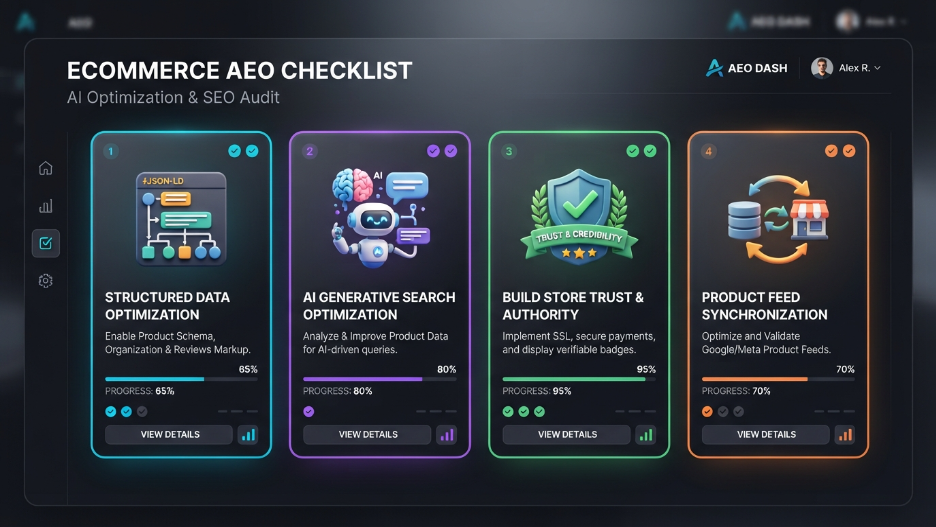
- Product descriptions state facts plainly, without relying on vague marketing language
- Schema markup covers product, review, price, and availability data
- Categories and attributes are connected into a coherent knowledge graph
- FAQ content mirrors natural, conversational phrasing
- Reviews are genuine, current, and structured for AI systems to read
Improving Ecommerce Search Visibility Across AI Platforms
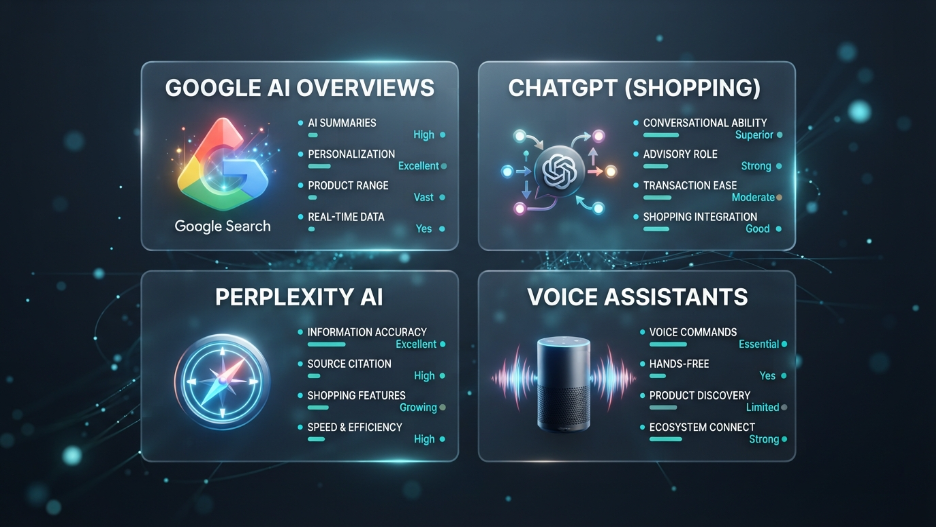
Real ecommerce search visibility today means showing up correctly across several different AI surfaces, not just one dominant search engine.
Google AI Overviews
These summarized answers pull heavily from structured product data and genuine review signals. They reward stores that have already invested in clean schema, and they tend to favor pages that state price, availability, and specs plainly near the top.
ChatGPT and Perplexity Shopping Results
Both platforms tend to cite sources with clear, well-labeled content over pages that bury the actual product facts under promotional copy. Perplexity in particular shows its sources openly, so a well-structured product page has a direct path to being seen and clicked.
Voice and Conversational Assistants
Voice assistants typically read back a single answer, which makes structured, unambiguous content essential since there is no second option being offered. A product description written for scanning on a screen often fails here, since it was never meant to be read aloud.
AEO for Ecommerce Real-World Impact on Sales
Stores that treat AEO for ecommerce as a real workstream, not a side experiment, are already seeing measurable movement in AI-referred traffic. This holds true even in categories where organic search traffic has stayed flat.
A useful way to track that progress is share of citation, meaning how often a brand or product actually gets named when an AI system answers a category-level question. Running the same handful of buyer questions through the major AI platforms on a regular cadence gives a clear, repeatable read on ecommerce search visibility. For a deeper breakdown of what that impact looks like across different store sizes and categories, our ecommerce SEO services page walks through real examples.
The clearest early signal tends to show up in assisted conversions rather than last-click attribution. A shopper asks an AI assistant for a recommendation, researches further independently, then completes the purchase directly later. Standard analytics often miss that first touchpoint entirely, which means the real impact of AEO work can be larger than a dashboard initially suggests.
Getting Started Optimize for AI Answers
Start with the highest-traffic product pages first. Clean up the structured data, rewrite descriptions in plain factual language, and add a genuine FAQ section before expanding across the rest of the catalog.
Test progress by asking the major AI shopping search platforms the exact questions a buyer would ask, such as best category under price, and note whether the store gets named and how accurately. Our team can help Optimize for AI Answers across a full product range, starting with an audit of where current content is losing AI visibility.
Conclusion
AEO for ecommerce is not a replacement for everything a store already knows about running a business online. It is an added layer that decides whether AI systems recommend a store or skip past it entirely.
Traditional SEO still matters, and the two disciplines work side by side rather than competing. The stores investing in structured, accurate, genuinely answer-ready content now are the ones that will keep showing up when a shopper asks an AI assistant a direct question in 2026.
The stores that wait tend to learn the cost of skipping AEO the hard way, watching competitors get named in answers where their own products should have appeared.
Frequently Asked Questions
How much does AEO for ecommerce typically cost?
Costs vary depending on catalog size and how much existing content needs restructuring. Most stores start with an audit before committing to full-catalog optimization.
How long does it take to see results from AEO?
Early visibility changes can appear within weeks on fast-moving platforms like ChatGPT and Perplexity. Broader search visibility shifts typically take longer to stabilize.
Which AI platforms does AEO cover?
A solid AEO strategy covers Google AI Overviews, ChatGPT, Perplexity, and voice assistants together, since each platform reads structured data slightly differently.
Does AEO replace traditional SEO for ecommerce?
No, the two work together. Traditional SEO still drives organic rankings and traffic, while AEO determines whether AI systems cite and recommend products directly.
Do I need a developer to implement AEO?
Some schema and structured data work benefits from developer support. A large share of AEO work, including clearer product copy and better structured FAQs, can start with the content team alone.