
If your listing has stalled outside the top three, the cause is rarely a mystery. It is usually one or two local SEO mistakes quietly working against you in the background, things like a half-finished profile, mismatched contact details, or reviews nobody ever answered. Fix the profile fields, match your business name, address, and phone number everywhere it appears online, and stay active on reviews, and most listings start climbing again within a few weeks. This guide breaks down the ten mistakes doing the most damage right now, shows you how to spot which one applies to your business, and gives you a step-by-step path back up the map.
What Affects Your Google Maps Ranking
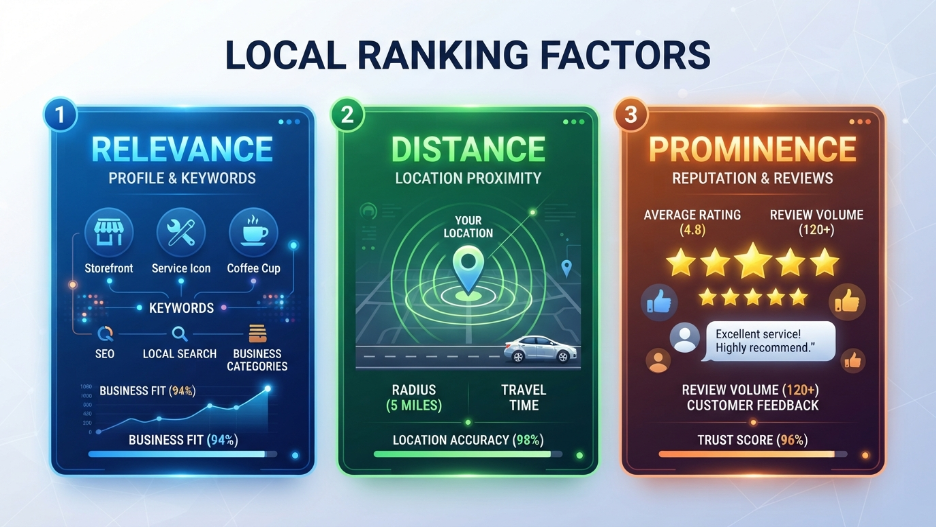
Google’s own local search documentation points to three pillars: relevance, distance, and prominence. Relevance measures how well your profile matches what someone typed in. Distance measures how close your business sits to the searcher or the location they typed in. Prominence measures how well known and well reviewed your business is, both on the web and off it.
These three pillars sit underneath every fix in this guide. When a listing underperforms, it is almost always because one of these three signals is weak, and weak signals are usually the direct result of the mistakes covered below.
Key Local Ranking Factors
| Ranking Factor | What It Measures | Common Weak Point |
| Relevance | How closely your profile matches the search query | Missing categories, thin descriptions |
| Distance | Proximity between searcher and business address | Wrong pin location, incorrect service area |
| Prominence | Overall reputation and citation footprint | Few reviews, inconsistent listings |
| Engagement | Clicks, calls, and direction requests from your profile | Outdated hours, no photos |
These are the local ranking factors that most influence who shows up first, and every mistake in this article maps back to one of them.
Have a look at this image to get a better understanding of local ranking factors.
How the Google Map Pack Works
The map pack is the block of three local results that appears above organic listings for location-based searches. Landing in it is less about tricking the algorithm and more about consistently feeding it clean, accurate, active signals. Your map pack ranking depends heavily on how complete your profile is, how consistent your business details are across the web, and how recently you have engaged with customers through reviews, posts, or Q&A.
Big Local SEO Mistakes That Hurt Your Rankings
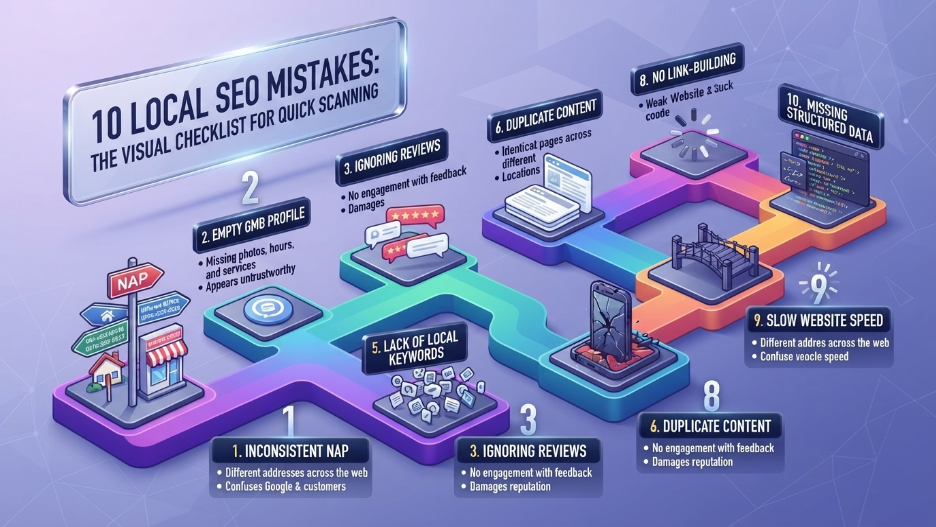
Below is a practical rundown of the common local SEO mistakes to avoid if you want steady, lasting visibility on the map. Each one is diagnostic, meaning you can check your own listing against it right now.
1. Incomplete or Unoptimized Google Business Profile
A profile missing categories, service areas, hours, or photos gives Google very little to match against search intent. This is the single most frequent issue found during listing audits, and it is entirely within your control to fix today.
Fill in every field the dashboard offers, add fresh photos monthly, and write a description that uses the language your customers actually search with. When you Optimize Google Business Profile fields completely, you give the algorithm far more to work with, and that alone often produces a visible jump in position within a few weeks.
2. Inconsistent NAP (Name, Address, Phone) Information
When your business name, address, or phone number differs even slightly across your website, citations, and directories, Google has to guess which version is correct. That hesitation shows up as a ranking penalty. NAP consistency is one of the clearest, most fixable signals of prominence, yet it is the one most owners never audit.
Run a quick search of your business name across the top ten directories and compare every field character by character. Suite numbers, abbreviations, and old phone numbers are the usual culprits.
3. Ignoring Customer Reviews and Responses
Reviews influence both prominence and conversion, and an unanswered review signals inactivity to anyone reading it, including Google. Businesses that respond to reviews within 24 to 48 hours tend to hold stronger positions than those that let them sit untouched for weeks.
A short, specific reply, thanking the customer and naming the service they used, does more for local relevance than a generic canned response ever will.
4. Missing or Weak Local Keyword Targeting
A profile and website that never mention the neighborhoods, suburbs, or service areas you actually cover will struggle to match hyper-local searches. Google leans on nearby text signals to confirm relevance for a given area.
Weave city and neighborhood names naturally into your business description, service pages, and posts, without stuffing them in awkwardly.
5. Poor On-Page Local SEO Signals
Your website is still part of the equation. A missing address in the footer, no embedded map, or a title tag that never mentions your city all weaken the connection between your site and your profile.
Add your full NAP details to the footer of every page, embed a map on your contact page, and make sure your city appears naturally in at least one heading.
6. Duplicate or Incorrect Business Listings
Old listings from a previous address, a rebrand, or an accidental second profile split your reviews, your citations, and your authority across two records instead of consolidating them into one.
Search your business name plus your city to find stragglers, then request merges or suspensions through Google’s support process rather than simply ignoring the duplicate.
7. Neglecting Local Citations and Directory Listings
Citations, meaning mentions of your business details on directories, chambers of commerce, and industry sites, reinforce prominence. A thin or outdated citation footprint leaves Google with fewer confirmations that your business is legitimate and active.
Prioritize the major data aggregators and industry-specific directories first, since they tend to carry the most weight and feed smaller directories automatically.
8. Not Using Location Pages for Multi-Location Businesses
Businesses with more than one location often route every visitor to a single homepage, leaving Google with no dedicated page to associate with each individual listing.
Build a unique page for every location, complete with its own address, phone number, embedded map, staff details, and locally relevant content, rather than duplicating the same template with only the city name swapped.
9. Skipping Local Schema Markup
Structured data does not directly boost rankings on its own, but it removes ambiguity for search engines trying to confirm your address, hours, and business type, which supports every other signal on this list.
Add LocalBusiness schema to your homepage and every location page, and keep the details in the markup identical to what appears on the visible page.
10. Never Run a Local SEO Audit
Without a periodic audit, small errors compound quietly for months before an owner notices the drop in calls or foot traffic.
Set a recurring quarterly check of your profile, citations, and reviews so new mistakes get caught before they cost you real visibility.
How These Mistakes Affect Your Google Business Profile and Map Pack Visibility
Each of the local SEO mistakes above chips away at a different ranking pillar, but they rarely act alone. A profile with thin categories and inconsistent NAP details, for example, weakens both relevance and prominence at the same time, which compounds the damage far beyond what either issue would cause on its own.
The practical effect is a listing that ranks fine for your exact business name but disappears for the generic searches that actually bring in new customers. Ongoing Google Business Profile optimization closes that gap by strengthening every pillar together instead of patching one signal while ignoring the rest, and it tends to have a direct, measurable effect on your local visibility within a single review cycle.
How to Improve Your Google Maps Ranking (Quick Fixes)
Once you know which mistakes apply to your listing, here is how to improve Google Maps ranking without guesswork. Work through the fixes below in roughly the order listed, since each one builds on the last.
Optimize Your Google Business Profile
Complete every available field, upload new photos regularly, and post updates at least twice a month. These Google Business Profile optimization tips are the fastest lever available, since most of them take minutes and show results within days.
Fix NAP Consistency Across Listings
Audit your top twenty citations, correct every mismatch, and set a standing rule that any future listing change gets mirrored everywhere at once, not just on your website.
Build Local Citations and Backlinks
Pursue listings on trusted local directories, local news mentions, and partnerships with nearby businesses that can link back to your site, favoring quality and relevance over sheer volume.
Encourage and Respond to Customer Reviews
Ask happy customers directly, make a review as short as one tap, and reply to every review, positive or negative, within two days.
Local SEO Checklist for Small Businesses
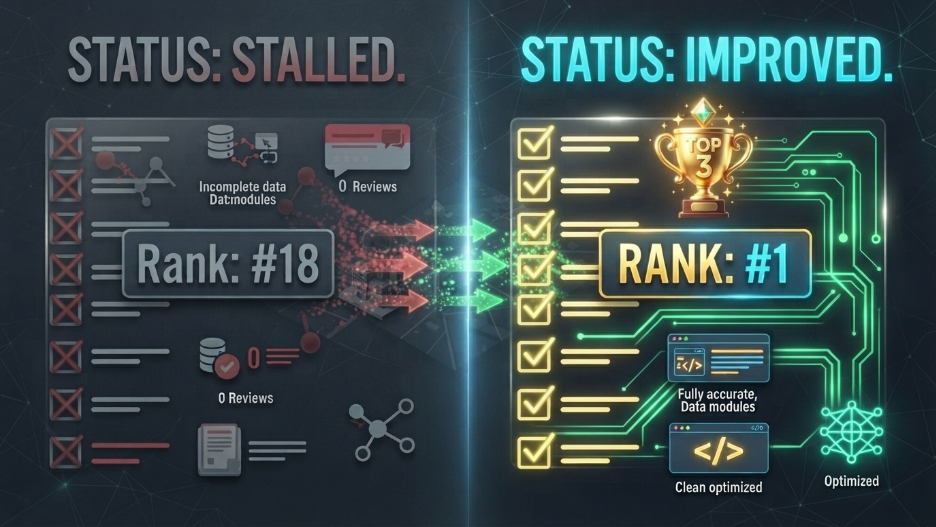
Use this quick reference whenever you want to sanity check a listing without re reading the full guide.
- Every profile field completed, including categories, hours, and service areas.
- Business name, address, and phone number identical across every listing.
- Reviews answered within 48 hours, both positive and negative.
- City and neighborhood names used naturally across the website and profile.
- NAP details visible in the website footer with an embedded map.
- No duplicate or outdated listings still active.
- Presence on the major citation aggregators and relevant local directories.
- A dedicated page for every physical location.
- LocalBusiness schema installed and accurate.
- A recurring quarterly audit scheduled on the calendar.
This local SEO checklist for small businesses works as a monthly recurring task, not a one time project, since new mistakes tend to creep back in after staff changes, rebrands, or office moves.
Why is My Business Not Ranking on Google Maps?
If you are asking why my business is not ranking on Google Maps, start by matching your symptoms to the table below.
| Symptom | Likely Cause |
| Ranks for your exact name, not general searches. | Weak relevance signals, thin categories or description. |
| Shows up in one area but not nearby suburbs. | Distance and service area misconfiguration. |
| Ranking dropped suddenly after a rebrand or move. | Inconsistent NAP details or a duplicate listing. |
| Ranks well but rarely gets calls or clicks. | Missing photos, outdated hours, or a weak profile description. |
| Competitors with fewer reviews outrank you. | Poor review response rate or thin citation footprint. |
Getting Professional Help to Fix These Mistakes
Some of these local SEO mistakes are quick weekend fixes. Others, particularly citation cleanup across dozens of directories or multi-location schema rollout, are genuinely time-consuming and easy to get wrong without experience.
If your internal team is stretched thin, working with a dedicated google maps ranking service can shortcut months of trial and error, particularly for businesses managing more than a handful of locations at once.
Major Points to Keep in Mind
- Incomplete profiles and mismatched NAP details are the two most common ranking killers for small businesses.
- Customer reviews carry real ranking weight. Ignoring them costs visibility, not just reputation.
- A clean citation profile and location-specific content matter more than most owners realize.
- Ranking recovery typically takes four to eight weeks after fixes go live, not overnight.
- The self-diagnosis section below tells you exactly which mistake is holding your listing back.
Final Verdict
Most ranking problems on Google Maps trace back to a short list of avoidable local SEO mistakes rather than some hidden algorithm penalty. Work through the profile, consistency, review, and citation issues covered here in order, recheck your listing against the checklist monthly, and the visibility you are chasing tends to follow.
Frequently Asked Questions (FAQs)
1. Why is my Google Maps ranking dropping?
A sudden drop usually follows a recent business change, a new duplicate listing, or a competitor improving their reviews and citations faster than you. Check for duplicate profiles and recent edits first.
2. Does NAP consistency affect local SEO?
Yes. Mismatched name, address, or phone details across the web weaken prominence and confuse Google about which listing is authoritative, which directly hurts ranking.
3. How do customer reviews impact Google Maps rankings?
Reviews feed prominence and signal ongoing activity. Volume, recency, and how consistently you respond all factor into how favorably Google treats your listing.
4. What is the fastest way to improve local SEO?
Completing every field on your Google Business Profile and fixing obvious NAP mismatches usually produces the quickest visible movement, often within one to two weeks.
5. How often should I update my Google Business Profile?
Add new photos and posts at least twice a month, and review every field for accuracy at least once a quarter.
6. How can I rank higher in the Google Map Pack?
Strengthen relevance, distance, and prominence together by completing your profile, correcting citation mismatches, and maintaining a steady flow of recent, responded-to reviews.