
An SEO company core updates strategy combines proactive E-E-A-T improvements, technical SEO audits, and helpful content optimization before a Google update, then shifts to diagnosing ranking changes, identifying affected pages, and implementing targeted fixes afterward.
Every core update can cause unexpected traffic fluctuations, but understanding why rankings move makes recovery far more manageable. This guide explains what Google core updates are, why they affect websites differently, and the proven strategies SEO professionals use to minimize ranking losses and support long-term recovery.
What are Google Core Updates?
A Google core update is a broad change to Google’s overall search ranking systems, designed to improve how well results match search intent, not a targeted penalty against any specific site.
How Often Do Core Updates Happen
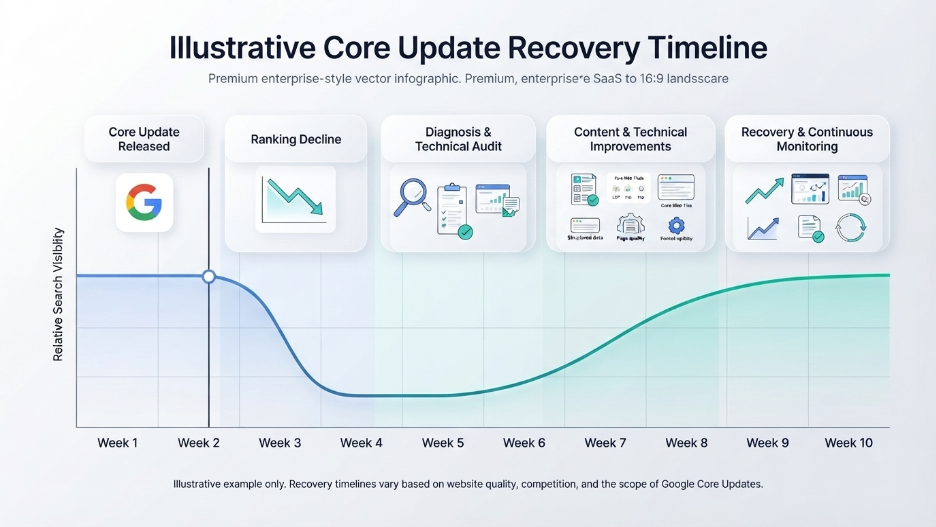
Google typically rolls out several confirmed core updates per year, though minor unconfirmed adjustments happen continuously in the background. Major updates are usually announced publicly and can take one to several weeks to fully roll out across all regions and search results.
Why Rankings Fluctuate After an Update
Rankings shift because Google is re-evaluating relevance and quality signals across its entire index simultaneously, not adjusting one site in isolation. A page that ranked well under the previous system may simply be outranked by content that better satisfies the update’s refined quality standards, which is why some sites see no visible change at all, while direct competitors in the same niche see significant movement in either direction.
It’s also worth noting that a core update doesn’t “target” any single site the way a manual action does. Two competitors can publish similarly structured content and see opposite outcomes, simply because one already had stronger underlying trust and expertise signals heading into the rollout.
Why Website Rankings Drop After a Core Update
Ranking drops after a core update almost always trace back to a gap between what a page offers and what Google’s updated systems now consider genuinely helpful and trustworthy.
Major Ranking Fluctuation Patterns
- Sudden, sitewide drops — usually signal broad content quality or E-E-A-T concerns across many pages, rather than an issue isolated to one section of the site.
- Isolated page-level drops — often point to specific pages with thin, outdated, or poorly sourced content, while the rest of the site holds steady.
- Fluctuating rankings during rollout — normal and expected while Google’s systems are still processing the update across all data centers, sometimes over a period of one to two weeks.
- Delayed drops weeks after rollout completes — can indicate secondary, related algorithm adjustments still being applied, which is why monitoring shouldn’t stop the moment an official rollout is marked complete.
- Partial recovery followed by a plateau — common when initial fixes address the most obvious issues but deeper content or authority gaps remain unresolved.
Content Quality Signals Google Evaluates
- Depth and originality of the content relative to competing pages already ranking well for the same query.
- Clear demonstration of first-hand experience or subject-matter expertise, not just accurate but generic information anyone could publish.
- Accuracy and currency of factual information, especially for topics where data, pricing, or regulations change frequently.
- Whether the content genuinely satisfies the searcher’s underlying intent, not just the keyword, a page can be accurate, and still underperform if it answers the wrong version of the question.
- Author and site-level trust signals, including transparent sourcing, clear authorship, and a track record of consistent quality across the domain.
How SEO Companies Protect Rankings Before a Core Update
The most effective protection against core updates happens long before one is even announced, through consistent, ongoing site maintenance rather than reactive scrambling.
Continuous E-E-A-T Alignment
Reputable SEO teams treat E-E-A-T SEO guidelines as an ongoing content standard, not a one-time checklist. This means regularly updating author bios, citing credible sources, and ensuring published content reflects real expertise rather than generic, AI-assisted summaries with no added insight.
Helpful Content Optimization
Content is reviewed periodically to confirm it still answers the searcher’s actual question as thoroughly as competing top-ranking pages. Outdated statistics, thin sections, and pages built primarily around keywords rather than genuine user value are flagged and rewritten before they become liabilities.
Proactive Technical SEO Audits
Site speed, mobile usability, crawlability, and structured data are checked on a recurring schedule rather than only after something breaks. Many businesses rely on ongoing technical seo services to catch these issues early, since unresolved technical debt tends to compound the negative impact of a core update rather than staying neutral.
How SEO Companies Respond After a Core Update Hits
Once an update rolls out and rankings shift, the response process shifts from prevention to diagnosis and targeted correction.
Analyzing Ranking Fluctuations
The first step is confirming the drop is actually tied to the core update, not a separate technical issue, manual action, or tracking error, by cross-referencing the timing against Google’s official rollout dates.
Identifying Affected Pages
Analytics and search console data are segmented to isolate exactly which pages, templates, or content categories lost visibility, rather than treating the entire site as uniformly affected.
Content and Technical Fixes for Recovery
Fixes are prioritized based on impact — pages with the highest historical traffic or revenue contribution are usually addressed first, followed by broader, sitewide content and technical improvements.
Core Update Recovery Process (Step-by-Step)
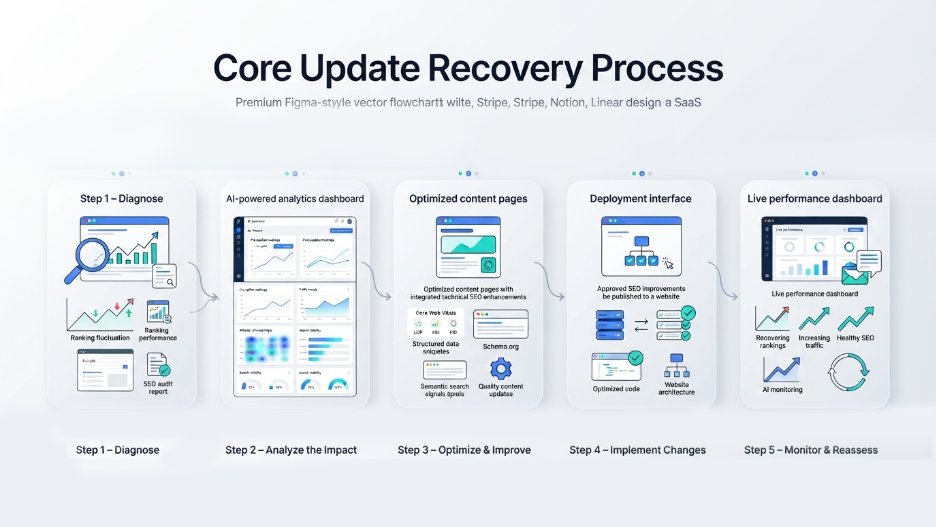
Step 1 – Diagnose the Ranking Drop Confirm the timing matches a known core update and rule out unrelated causes like indexing errors or manual penalties.
Step 2 – Audit Content Against E-E-A-T Guidelines Review affected pages for expertise signals, source credibility, and overall depth compared to current top-ranking competitors.
Step 3 – Fix Technical SEO Issues: Resolve crawl errors, slow load times, and structured data problems that may be compounding the content-related ranking loss.
Step 4 – Improve Helpful Content Signals: Rewrite or expand thin sections, update outdated data, and ensure content clearly demonstrates first-hand knowledge or experience.
Step 5 – Monitor Rankings and Reassess: Track ranking movement over several weeks, since Google core update recovery rarely happens instantly, and adjust the approach based on which fixes are showing measurable impact.
Long-Term Strategies to Protect Rankings from Future Core Updates
Building Topical Authority
Publishing comprehensive, interlinked content around a core subject area signals depth of expertise to Google, making individual pages less vulnerable to isolated quality reassessments. Sites that cover a topic broadly and link related pages together tend to weather updates more predictably than those with scattered, disconnected content.
Strengthening E-E-A-T Signals
Ongoing investment in visible author credentials, original research or data, and transparent sourcing builds a trust foundation that tends to hold up better across successive updates. This is less about adding a bio box once and more about consistently publishing content that reflects genuine, verifiable expertise over time.
Regular Technical SEO Maintenance
Scheduled audits, covering site speed, mobile experience, crawl health, and structured data accuracy, prevent technical debt from quietly accumulating between major algorithm changes. A site that’s technically clean going into an update has one less variable working against it during a volatile ranking period.
Diversifying Traffic Sources
Relying on organic search alone leaves a business fully exposed to algorithm volatility. Building complementary channels, email, direct traffic, and referral partnerships, reduces how much a single core update can affect overall revenue, even if search rankings temporarily dip.
Why Businesses Partner with an SEO Company for Core Update Protection
Most in-house marketing teams don’t have the bandwidth to track algorithm rollouts, benchmark against E-E-A-T guidelines, and run technical audits on a continuous basis while also managing everyday content and campaign work. An experienced SEO company brings dedicated monitoring, established diagnostic processes, and pattern recognition from having navigated multiple past updates across different client sites, turning what feels like guesswork for a single business into a repeatable, evidence-based process.
To Wrap Up
Protecting rankings from Google core updates isn’t about predicting exactly what the next algorithm change will target, it’s about maintaining consistently high content quality, strong E-E-A-T signals, and clean technical SEO health so that whatever the update evaluates, your site already measures up. The businesses that recover fastest are almost always the ones that were already close to compliant before the update rolled out, not the ones starting from zero afterward. Treat core update readiness as ongoing maintenance, not a one-time fire drill, and the swings will matter far less over time.
Frequently Asked Questions (FAQs)
1. How do SEO companies handle Google core updates?
They combine proactive measures, E-E-A-T alignment, content audits, and technical SEO maintenance, with a structured post-update response process to diagnose drops and prioritize fixes on the highest-impact pages first.
2. How can I protect my website from Google core updates?
Focus on demonstrable expertise, accurate and current content, strong technical performance, and genuinely helpful pages that satisfy search intent rather than just targeting keywords.
3. What should you do after a Google core update?
Confirm the drop aligns with the update’s rollout dates, identify which specific pages lost visibility, and prioritize content and technical fixes based on traffic or revenue impact before reassessing after several weeks.
4. Why do website rankings drop after a core update?
Rankings typically drop when a page’s content quality, expertise signals, or technical performance no longer measure up as well as competing pages under Google’s refined evaluation criteria.